
Human–AI Systems

I design how intelligence, decisions, workflows, and people work together.

AI does not operate in isolation.

It interacts with people, workflows, and decisions.

Most systems are not designed for that interaction.

Understand your situation
Start Strategic Inquiry

AI systems without structure don’t work

Many AI initiatives fail not because of technology.

But because:
  • decisions are not defined
  • workflows are not aligned
  • roles are unclear
  • outputs are not actionable

AI becomes valuable only when it is embedded in a working system.

From Intelligence to Decisions

A human–AI system is not a tool stack.

It is a structured interaction between:

  • intelligence
  • decisions
  • workflows
  • people
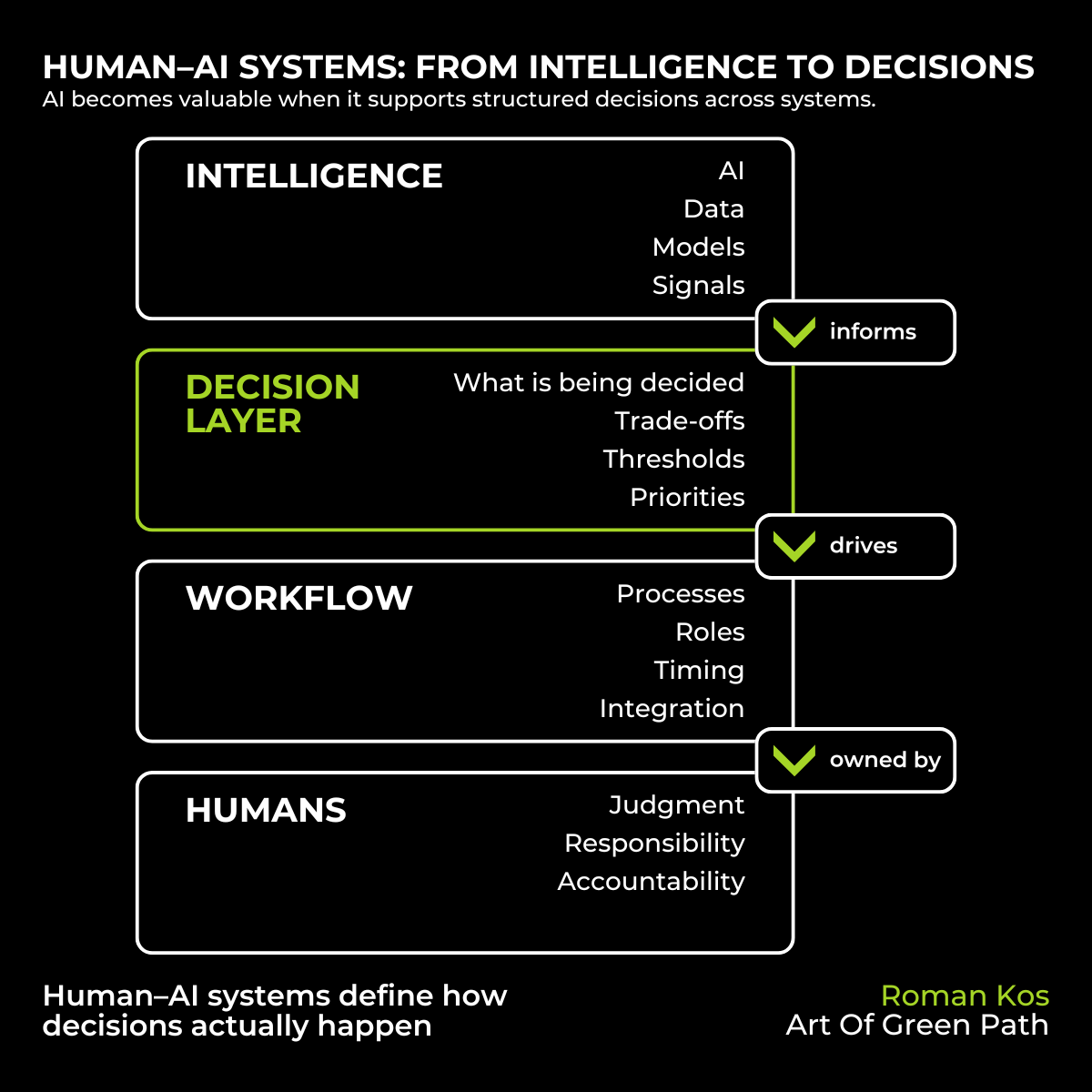
Diagram by Roman Kos illustrating human–AI systems and AI decision systems design. The visual shows how intelligence from AI, data, models, and signals is translated into structured decisions through a decision architecture layer. It includes four layers: Intelligence, Decision Layer (trade-offs, thresholds, priorities), Workflow (processes, roles, integration), and Humans (judgment, responsibility, accountability). Arrows indicate that AI informs decisions, decisions drive workflows, and humans retain ownership. The diagram highlights how AI becomes valuable when embedded in decision systems and real-world contexts.

A system works when these layers are aligned.

If one layer is missing:

  • intelligence becomes unused
  • decisions become unclear
  • workflows break
  • responsibility dissolves

What human–AI systems define

Human–AI systems define:

  • how intelligence is used
  • how decisions are made in practice
  • how workflows support those decisions
  • how roles and responsibilities are structured

They turn AI capability into real execution.

Connected to decision architecture

Decision architecture defines:

  • what decisions exist
  • how they are structured

Human–AI systems define:

  • how those decisions happen
  • how people and AI interact

Together, they make systems operational.

→ Explore Decision Architecture

Where this becomes critical

  • AI strategy and transformation
  • natural capital and ecological systems
  • intelligence platforms
  • multi-stakeholder environments
  • learning and capability systems

Ways to work together

Different situations require different entry points.

Each engagement is designed to move from:

clarity → decision → action

Decision Snapshot

A short structured orientation that clarifies what is actually being decided before time, money, or authority are committed.

This is where most work begins.

→ Start Your Decision Snapshot

AI Decision Mapping Session

Focused leadership alignment to identify where AI should fit, what matters first, and what creates the strongest ROI before implementation begins.

Often the best first paid engagement.

→ Explore AI Decision Mapping Session

Discovery Sprint

Structured work to define AI strategy, future system direction, and human–AI participation.

→ Explore Discovery Sprint

Decision Clarity Sprint

Focused work on one major high-stakes decision where sequencing, trade-offs, and commitment matter.

→ Explore Decision Clarity Sprint

Strategic Inquiry

Deeper work across decision architecture, human–AI systems, and ecosystem-level strategy.

→ Start Strategic Inquiry

How this work happens

This work focuses on aligning all layers of the system.

Steps

  • define decision layer
  • align intelligence inputs
  • structure workflows
  • clarify roles and ownership

Make AI work in practice

AI systems only create value when decisions and execution are aligned.

Understand your situation Start Strategic Inquiry