
Decision Architecture & AI Strategy

Structure how decisions are made in complex, AI-driven environments.

Most organizations are improving intelligence.

But decisions remain unclear, slow, or misaligned.

Decision architecture defines how decisions actually happen.

Understand your situation Start Strategic Inquiry

We built intelligence. Decisions still stall.

AI, data, and analysis are improving rapidly.

But in many environments:
  • decisions are unclear
  • ownership is fragmented
  • trade-offs are not explicit
  • execution breaks down

The issue is not lack of intelligence.

It is lack of structure around decisions.

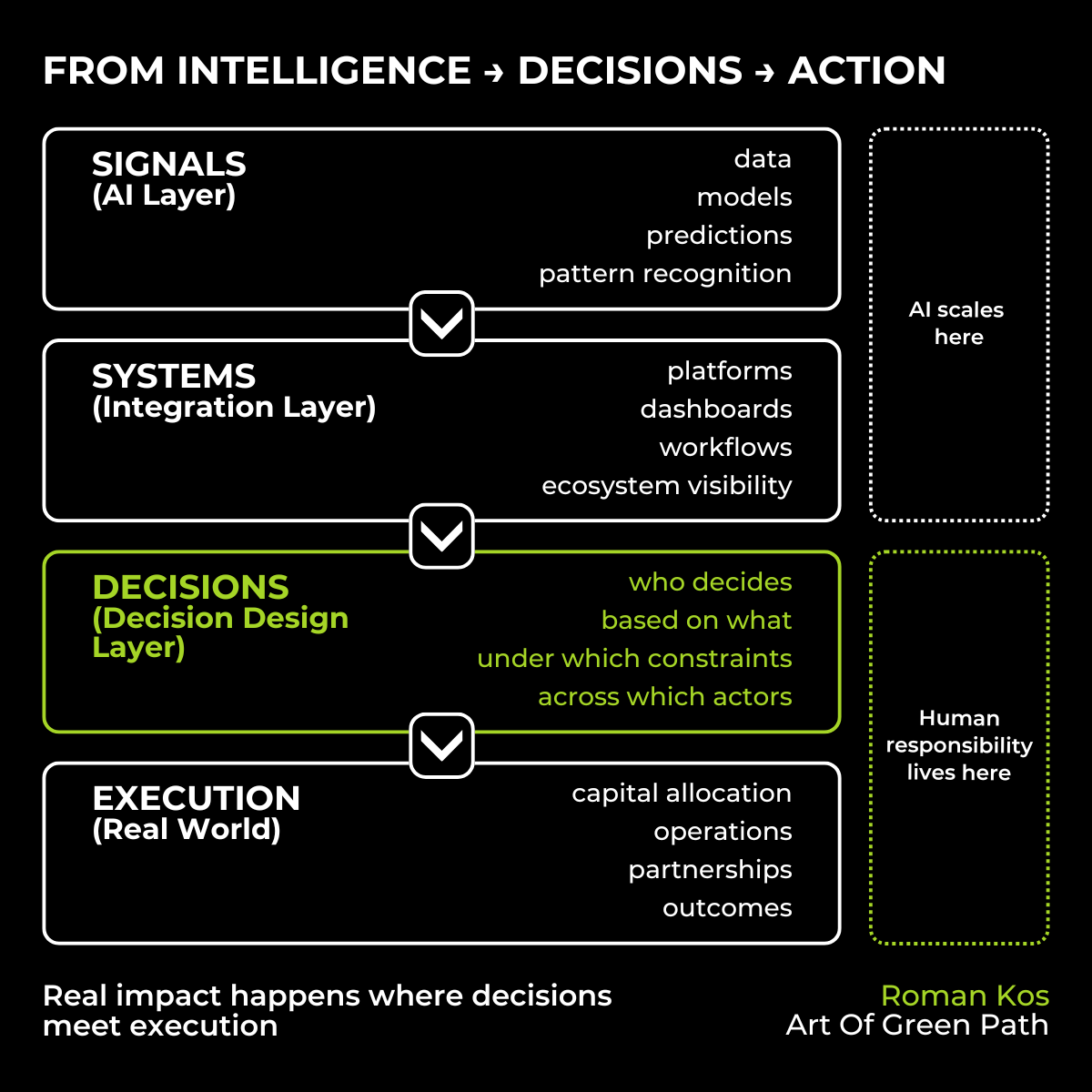
From intelligence to decisions to action

Most systems stop at intelligence.

Real value comes from connecting intelligence to decisions and action.

ayered AI decision architecture diagram by Roman Kos showing how intelligence becomes real-world action. The model includes Signals (AI layer with data, models, predictions), Systems (integration layer with platforms, dashboards, workflows), Decisions (decision design layer defining who decides, based on what, under which constraints, across actors), and Execution (capital allocation, operations, partnerships, outcomes). The visual emphasizes that AI scales at the intelligence layer, while decision architecture connects intelligence to execution and enables effective AI strategy and decision systems.

Intelligence does not move systems.

Decisions do.

And decisions only work when:

  • they are clearly defined
  • trade-offs are explicit
  • ownership is structured
  • execution is connected

Real impact happens where decisions meet execution.

What decision architecture does

Decision architecture defines:

  • what decisions exist
  • what inputs matter
  • how trade-offs are evaluated
  • who is responsible
  • how decisions translate into action

It turns complexity into structured, actionable choices.

Where this becomes critical

Decision architecture becomes essential in environments such as:

  • AI strategy and transformation
  • natural capital and ecological systems
  • capital allocation and investment decisions
  • multi-stakeholder ecosystems
  • complex operational systems

This is for you if

  • you are making high-stakes strategic decisions
  • AI is influencing your direction
  • multiple stakeholders are involved
  • decisions feel unclear or fragmented

Connected to human–AI systems

Decision architecture and human–AI systems are closely linked.

Decision architecture defines:

  • what decisions exist
  • how they are structured

Human–AI systems define:

  • how those decisions happen in practice
  • how intelligence, workflows, and people interact

Together, they make decisions possible, usable, and actionable.

→ Explore Human–AI Systems

Ways to work together

Different situations require different entry points.

Discovery Sprint

Structured session to define your AI strategy and system direction.

→ Explore Discovery Sprint

Decision Clarity Sprint

Focused work on a specific high-stakes decision.

→ Explore Decision Clarity Sprint

Advisory & system design

Ongoing work across decision architecture and human–AI systems.

→ Explore System Design

How this work happens

This work is not theoretical.

It is applied directly to your context, decisions, and systems.

Steps

  1. clarify decision landscape
  2. structure key decisions
  3. align decisions with execution

Bring structure to your decisions

If decisions are unclear, everything slows down.

Clarity changes that.

Understand your situation Start Strategic Inquiry