
Ecosystem Strategy & Decision Infrastructure

Designing how intelligence becomes clear, aligned decisions across capital, systems, and real-world execution.

Understand your situation Start Strategic Inquiry

The bottleneck has shifted

Many ecosystems already have:

  • strong intelligence
  • emerging capital
  • validated use cases

Yet decisions remain slow and fragmented.

The constraint is no longer insight.

It is how decisions are structured across actors.

As systems scale, the bottleneck shifts from insight to coordination.

Where this becomes critical

This challenge is most visible in systems where intelligence, capital, and real-world execution must align.

Natural capital & ecological assets

Land, ecosystems, and long-term value.

Where:

  • assets are finite
  • measurement and verification are improving
  • capital is entering the space

But decisions must align:

  • risk and return
  • time horizons
  • capital allocation
  • real-world constraints

Earth intelligence & AI systems

Geospatial AI, environmental data, and modeling.

Where:

  • intelligence is accelerating
  • outputs are increasingly sophisticated

But outputs are often not:

  • decision-ready
  • comparable
  • actionable for operators or investors

Climate and cross-sector ecosystems

Platforms, initiatives, and collaborative environments.

Where:

  • actors are aligned in intent
  • solutions are emerging

But execution remains fragmented across:

  • organizations
  • incentives
  • timelines

Across these environments, the constraint is not insight.
It is how decisions are structured across actors.

Example: Natural capital systems

In natural capital systems:

  • assets are real and finite
  • intelligence is improving rapidly
  • capital is increasing

But decisions remain difficult to structure across investors, operators, and partners.

Without clear decision environments, strong fundamentals do not translate into action.

→ Explore Decision Architecture

Ways to work together

Different situations require different entry points.

Each engagement is designed to move from:

clarity → decision → action

Decision Snapshot

A short structured orientation that clarifies what is actually being decided before time, money, or authority are committed.

This is where most work begins.

→ Start Your Decision Snapshot

AI Decision Mapping Session

Focused leadership alignment to identify where AI should fit, what matters first, and what creates the strongest ROI before implementation begins.

Often the best first paid engagement.

→ Explore AI Decision Mapping Session

Discovery Sprint

Structured work to define AI strategy, future system direction, and human–AI participation.

→ Explore Discovery Sprint

Decision Clarity Sprint

Focused work on one major high-stakes decision where sequencing, trade-offs, and commitment matter.

→ Explore Decision Clarity Sprint

Strategic Inquiry

Deeper work across decision architecture, human–AI systems, and ecosystem-level strategy.
→ Start Strategic Inquiry

Decision Infrastructure

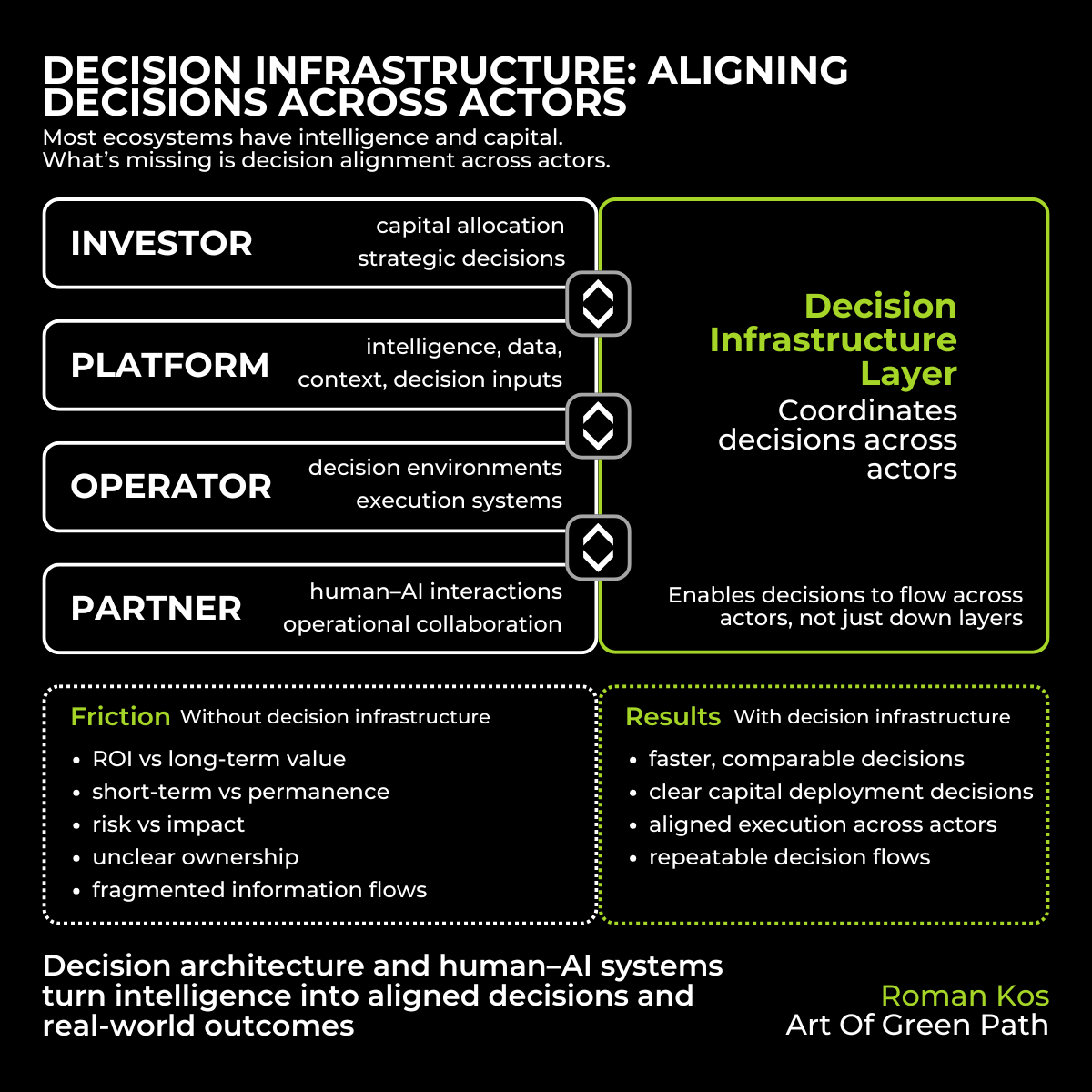
Between intelligence and action, there is a missing layer.

Decision infrastructure defines:

  • what decisions exist
  • what inputs are required
  • how trade-offs are evaluated
  • who owns each decision
  • how decisions move across actors

Without this layer:

  • capital hesitates
  • outputs remain unused
  • coordination breaks

Strong intelligence does not automatically create actionable decisions.

Ecosystem-level decision infrastructure diagram by Roman Kos showing how decision systems align multiple stakeholders. The visual includes four actors: Investor (capital allocation, strategic decisions), Platform (intelligence, data, context, decision inputs), Operator (decision environments, execution systems), and Partner (human–AI interactions, operational collaboration). A central decision infrastructure layer coordinates decisions across actors and enables cross-system decision flows. The diagram contrasts fragmented ecosystems with aligned systems, highlighting benefits such as faster decisions, clear capital deployment, and coordinated execution across AI, capital, and natural systems.

Strong ecosystems are not defined only by data or assets.

They are defined by how decisions are made across the system.

→ See Human–AI Systems

Where I work

I design how systems become decision-capable across actors.

This includes:

  • structuring decision environments
  • aligning human and AI roles
  • defining workflows and ownership
  • enabling decisions across organizations and ecosystems
Work With Me

When this work is needed

This work becomes critical when systems reach a point where:

  • decisions remain unclear despite strong data
  • multiple actors must align around action
  • systems scale faster than coordination
  • capital requires structured decision-making

Capital moves when decisions become clear.

Understand your situation Start Strategic Inquiry