
Human–AI systems are decision systems

AI becomes valuable when it is embedded into how decisions, workflows, and responsibilities are structured.The question is not what AI can do, but how humans and AI operate together inside a system.

→ Work With Me

→ Start Here


Why most AI implementations stall

Many AI initiatives focus on tools, models, or automation.

But the real challenge is not capability. It is structure.

AI is introduced into environments where:

  • roles are unclear
  • ownership is fragmented
  • decision thresholds are undefined
  • outputs do not fit real workflows

As a result:

  • intelligence grows
  • but action does not

AI does not fail. Systems around it do.

From tools to systems

AI should not be treated as a standalone capability.

It is part of a system that includes:

  • people
  • workflows
  • decisions
  • constraints
  • incentives

The real design challenge is not the tool.

It is how the system operates.

What defines a strong human–AI system

A human–AI system is effective when:

1. Decisions are clearly defined
What is being decided, and why it matters.

2. Roles are explicit
What AI does. What humans do. Where responsibility stays.

3. Outputs are usable
Not just insight, but decision-ready inputs.

4. Thresholds are visible
When to act, when to review, when to escalate.

5. Workflows are integrated
AI fits into how work actually happens.

6. Feedback loops exist
Systems improve over time through use.

From Intelligence to Structured Decisions

Most AI systems stop at intelligence.
But intelligence alone does not create value.

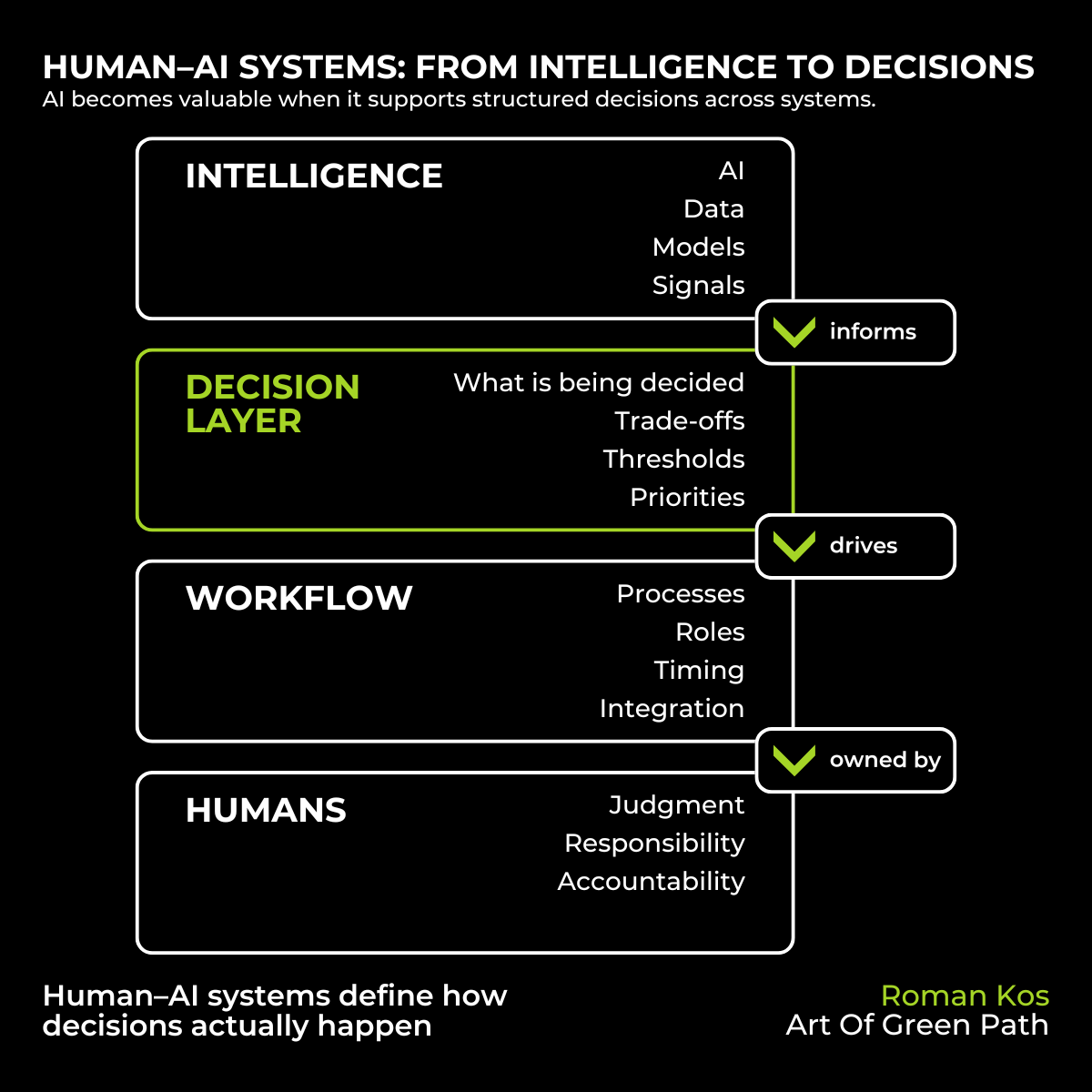
Value emerges when intelligence is translated into structured, repeatable decisions inside real systems.

Diagram by Roman Kos illustrating human–AI systems and AI decision systems design. The visual shows how intelligence from AI, data, models, and signals is translated into structured decisions through a decision architecture layer. It includes four layers: Intelligence, Decision Layer (trade-offs, thresholds, priorities), Workflow (processes, roles, integration), and Humans (judgment, responsibility, accountability). Arrows indicate that AI informs decisions, decisions drive workflows, and humans retain ownership. The diagram highlights how AI becomes valuable when embedded in decision systems and real-world contexts.

I design human–AI systems that define:

  • what is being decided
  • how trade-offs are evaluated
  • how decisions integrate into workflows
  • where human responsibility remains

This is the layer where AI becomes operational, accountable, and useful.

Where human–AI systems become critical

AI strategy & transformation

  • prioritization
  • workflow redesign
  • capability integration

Natural capital & environmental systems

  • land and asset evaluation
  • ecological decision-making
  • multi-stakeholder coordination

Geospatial and intelligence systems

  • site selection
  • modeling outputs → decisions
  • practitioner use

Learning and capability systems

  • students, mentors, leaders
  • structured decision environments
  • human–AI learning intelligence

How I design human–AI systems

My work focuses on the layer where intelligence becomes usable.

This includes:

  • structuring decision environments
  • defining human–AI interaction
  • aligning stakeholders and roles
  • translating outputs into action
  • designing systems that scale beyond individuals

Not adding AI into systems, but designing systems around AI.

Connected to decision architecture

Human–AI systems and decision architecture are closely linked.

Decision architecture defines:

  • what decisions exist
  • how they are structured

Human–AI systems define:

  • how those decisions happen in practice

→ Explore Decision Architecture

Ways to work together

Discovery Sprint

Structured session to define your AI strategy and system direction

→ Explore Discovery Sprint

Decision Clarity Sprint

Focused work on a specific high-stakes decision

→ Explore Decision Clarity Sprint

Advisory & system design

Ongoing support for designing and evolving human–AI systems

→ Work With Me

AI does not create clarity.

Systems do.

The organizations that benefit most from AI will not be those with the most tools.

They will be the ones that design how decisions happen.

→ Start Here

→ Strategic Inquiry