Decision Architecture & Human–AI Systems

For leaders navigating AI, high-stakes decisions, and complex transformation.

I design how intelligence becomes clear, aligned, and accountable decisions across people, systems, and ecosystems.

Before tools scale, workflows automate, or commitments become expensive, the real work is defining what is actually being decided.

Clarity before scale.
Architecture before automation.
Responsibility before delegation.

Start with a Decision Snapshot Ways To Work Together

Start with a Decision Snapshot

Most work begins here.

A Decision Snapshot is a short, structured clarity artifact that helps define what is actually being decided before time, money, or authority are committed.

It identifies decision friction, system gaps, and the strongest next step—whether that is a focused report, a sprint, or deeper system design.

Generated through the AI Clarity Quiz, it creates clarity before speed creates irreversible exposure.

→ Start your Decision Snapshot

→ Learn how Decision Snapshot works

We've built intelligence.
Now we need decisions.

AI is rapidly improving how we understand complex systems.

More data.
Better models.
Faster analysis.

But better intelligence does not automatically lead to better decisions.

In most organizations:

  • ownership is unclear
  • trade-offs are unstructured
  • decisions do not match how people actually operate

So intelligence grows.
And decisions stall.

→ Explore Decision Architecture

From intelligence to decisions

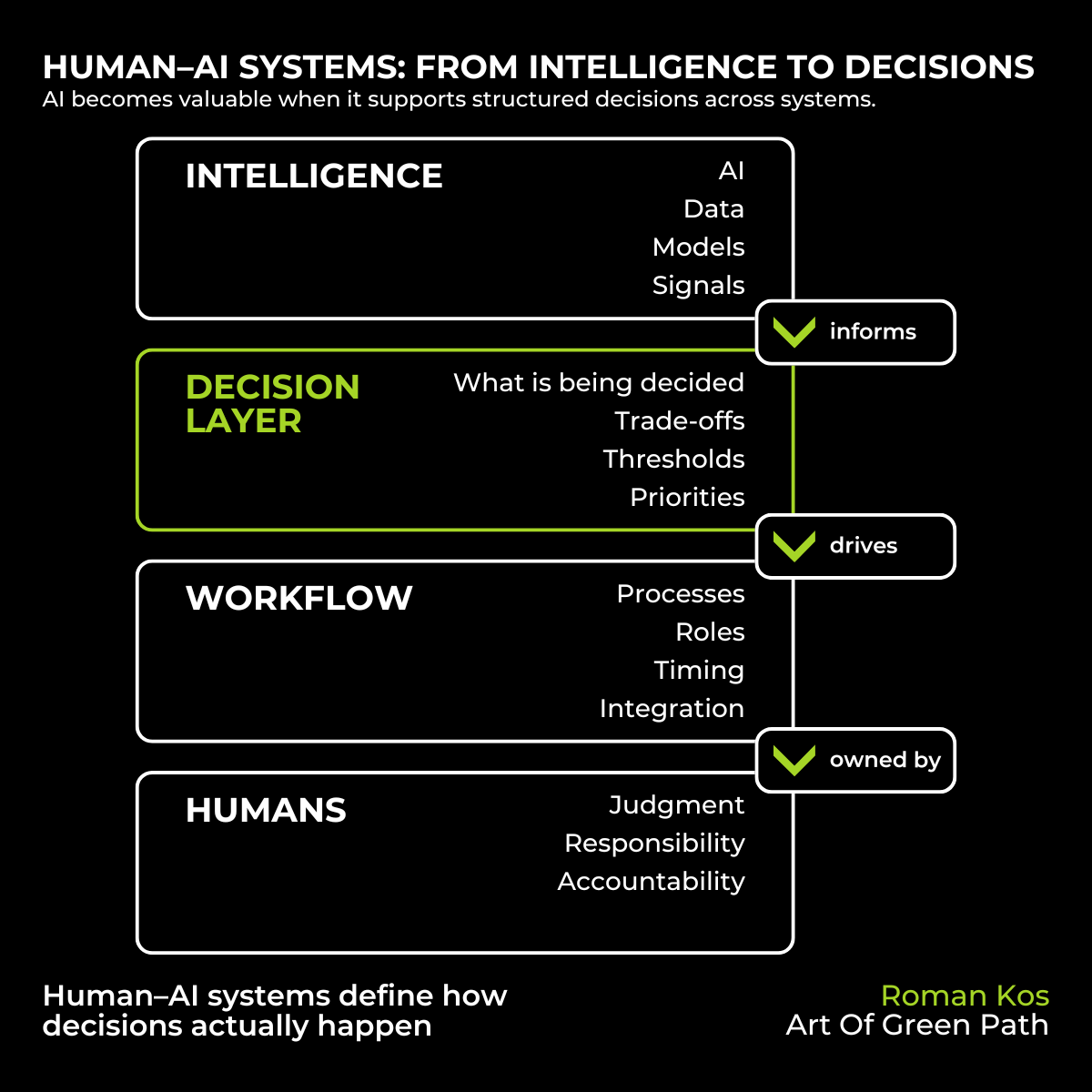
A human–AI system is not a tool stack.

It is a structured interaction between:

  • intelligence
  • decisions
  • workflows
  • people

AI creates value only when these layers are aligned.

If one layer is missing:

  • intelligence becomes unused
  • decisions become unclear
  • workflows break
  • responsibility dissolves
Diagram by Roman Kos illustrating human–AI systems and AI decision systems design. The visual shows how intelligence from AI, data, models, and signals is translated into structured decisions through a decision architecture layer. It includes four layers: Intelligence, Decision Layer (trade-offs, thresholds, priorities), Workflow (processes, roles, integration), and Humans (judgment, responsibility, accountability). Arrows indicate that AI informs decisions, decisions drive workflows, and humans retain ownership. The diagram highlights how AI becomes valuable when embedded in decision systems and real-world contexts. Work With Me

→ See Human–AI Systems

Where systems meet ecosystems

At the ecosystem level, the challenge shifts again.

In areas like:

  • natural capital
  • climate systems
  • AI-driven infrastructure

the problem is no longer insight.

It is:

  • aligning decisions across actors
  • translating intelligence into commitment
  • enabling coordinated execution

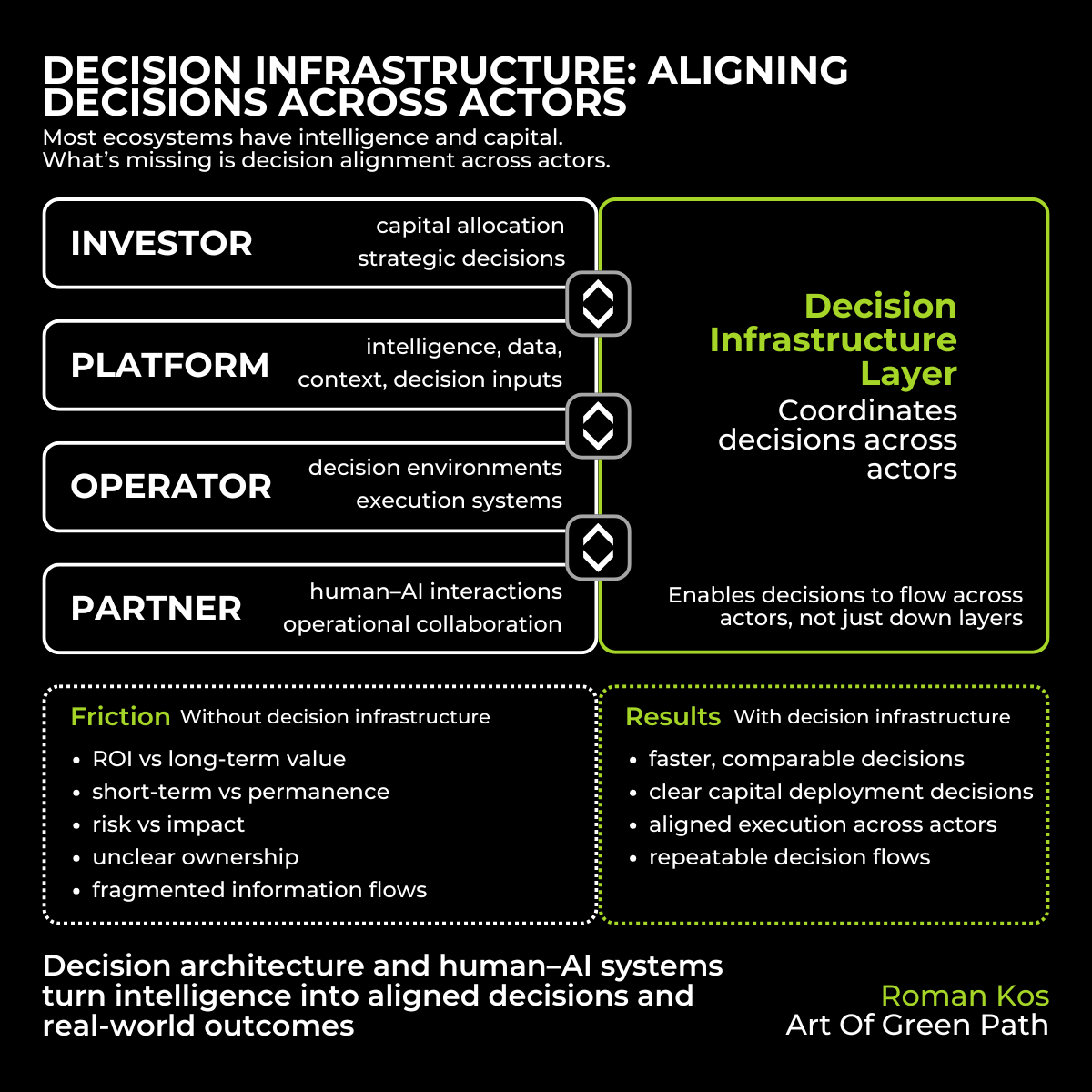
Most ecosystems already have:

  • strong intelligence
  • growing capital
  • increasing urgency

But decisions remain fragmented.

Ecosystem-level decision infrastructure diagram by Roman Kos showing how decision systems align multiple stakeholders. The visual includes four actors: Investor (capital allocation, strategic decisions), Platform (intelligence, data, context, decision inputs), Operator (decision environments, execution systems), and Partner (human–AI interactions, operational collaboration). A central decision infrastructure layer coordinates decisions across actors and enables cross-system decision flows. The diagram contrasts fragmented ecosystems with aligned systems, highlighting benefits such as faster decisions, clear capital deployment, and coordinated execution across AI, capital, and natural systems. Start Strategic Inquiry

→ Explore Decision Architecture

Roman Kos

Decision Architect & Human–AI Systems Strategist

I work at the intersection of:

  • decision architecture
  • human–AI systems
  • ecosystem-level strategy

My focus is designing how intelligence becomes clear, aligned, and actionable decisions across people, systems, and environments.

This includes:

  • structuring high-stakes decisions
  • aligning human and AI roles
  • designing decision environments
  • enabling coordination across organizations and ecosystems
About

How I work

Each engagement is designed around clarity, structure, and execution.

Depending on the context, this may include:

  • structuring decision environments
  • designing human–AI interaction
  • aligning workflows and responsibilities
  • enabling decisions across teams and systems

The goal is always the same:

Clear decisions.
Aligned systems.
Action that moves.

Work With Me

Where this becomes practical

AI strategy & transformation

Structuring how AI decisions are made across leadership, teams, and systems.

→ Discovery Sprint

High-stakes decision clarity

Bringing structure and confidence to complex decisions.

→ Decision Clarity Sprint

Strategic & ecosystem-level work

Designing decision environments across organizations and ecosystems.

→ System Design

Clarity changes decisions.
Decisions change systems.

If you are navigating AI strategy, high-stakes decisions, or ecosystem-level complexity, the next step is not more information.

It is clearer structure.

Whether the need is a focused decision, strategic direction, or human–AI system design, the goal is the same:

better decisions before irreversible commitments.

Start Strategic Inquiry Start with a Decision Snapshot